TECHNICAL SUMMARY
The structural design of 16-bit cartridges allowed for larger data storage and processing power. We analyze the PCB and ROM chips.
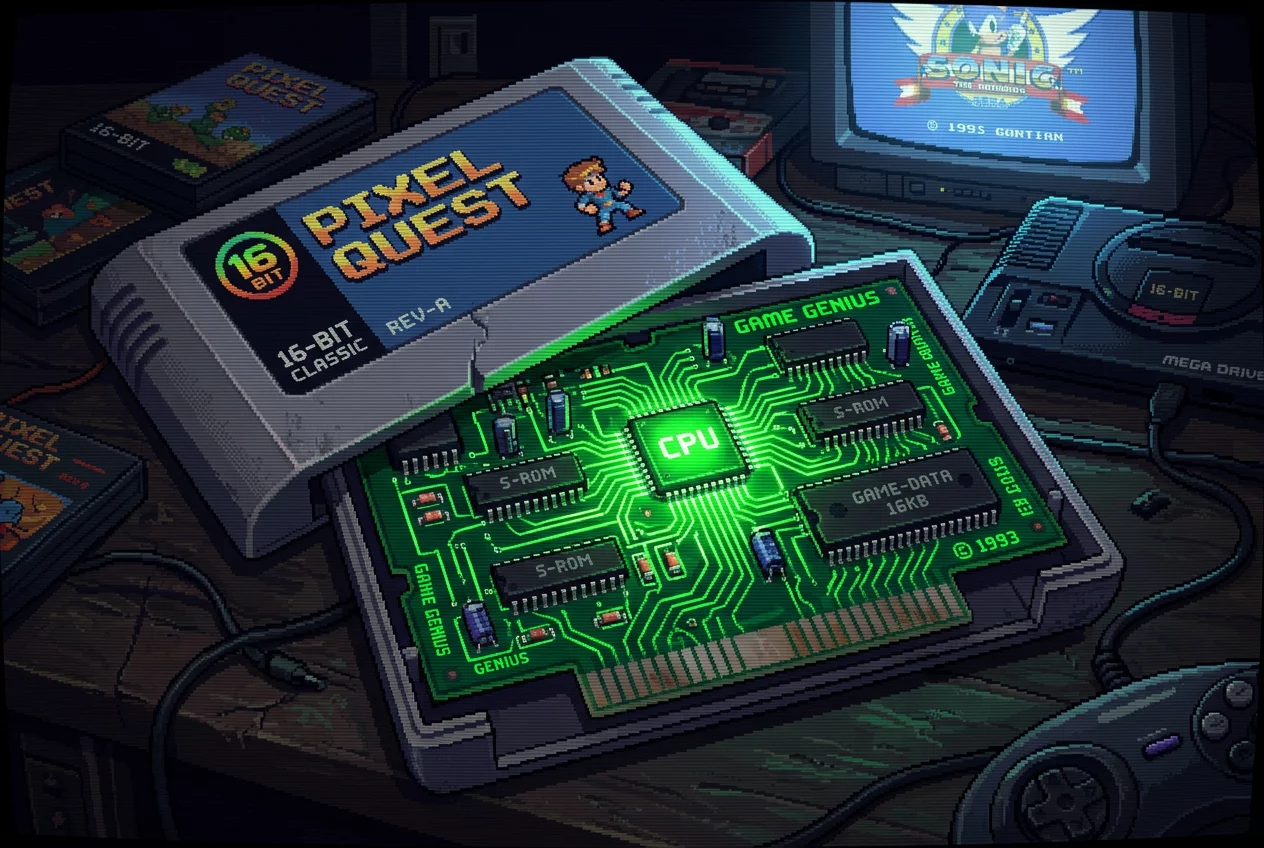
The 16-bit era brought with it a massive leap in hardware sophistication. Unlike their 8-bit predecessors, these cartridges often housed more than just a Read-Only Memory (ROM) chip. Engineers had to squeeze complex board layouts into plastic shells, dealing with challenges such as multi-megabit data handling and on-board processing enhancement.
Inside the shell, the Printed Circuit Board (PCB) acts as the nervous system. It connects the edge connector pins—those gold-plated strips we often blew air on—to the essential chips. The primary ROM chip contains the actual game data, while supplementary chips might handle specialized graphics tasks or mathematical calculations that the console's CPU couldn't manage alone.
Many 16-bit titles, especially long-form RPGs, required a constant power supply to maintain saved progress. This led to the integration of a small lithium battery (CR2032 or similar) soldered directly onto the PCB. This battery powers a tiny amount of Static RAM (SRAM), ensuring that your heroic journey remained intact even after the console was powered down.
Heat dissipation and electronic interference were also major concerns. Metal shielding was frequently used to reduce electromagnetic interference, ensuring that the heavy data flow didn't disrupt the television signal. Each component was carefully placed to fit perfectly within the unique physical silhouettes of the Japanese, American, and European cartridge variations.
TRANSMISSION LOGS
John Doe
2026-05-08Excellent teardown. I never realized how much extra logic was packed into those larger 16-bit boards compared to the NES days.
Mike Byte
2026-05-09My old RPG battery finally died last year. Had to learn how to solder just to keep my saves alive!
INITIATE TRANSMISSION