TECHNICAL SUMMARY
The elegance of 8-bit media lies in its straightforward circuitry, bridging the gap between arcade logic and home entertainment. These boards were the foundation of gaming before massive storage became common.
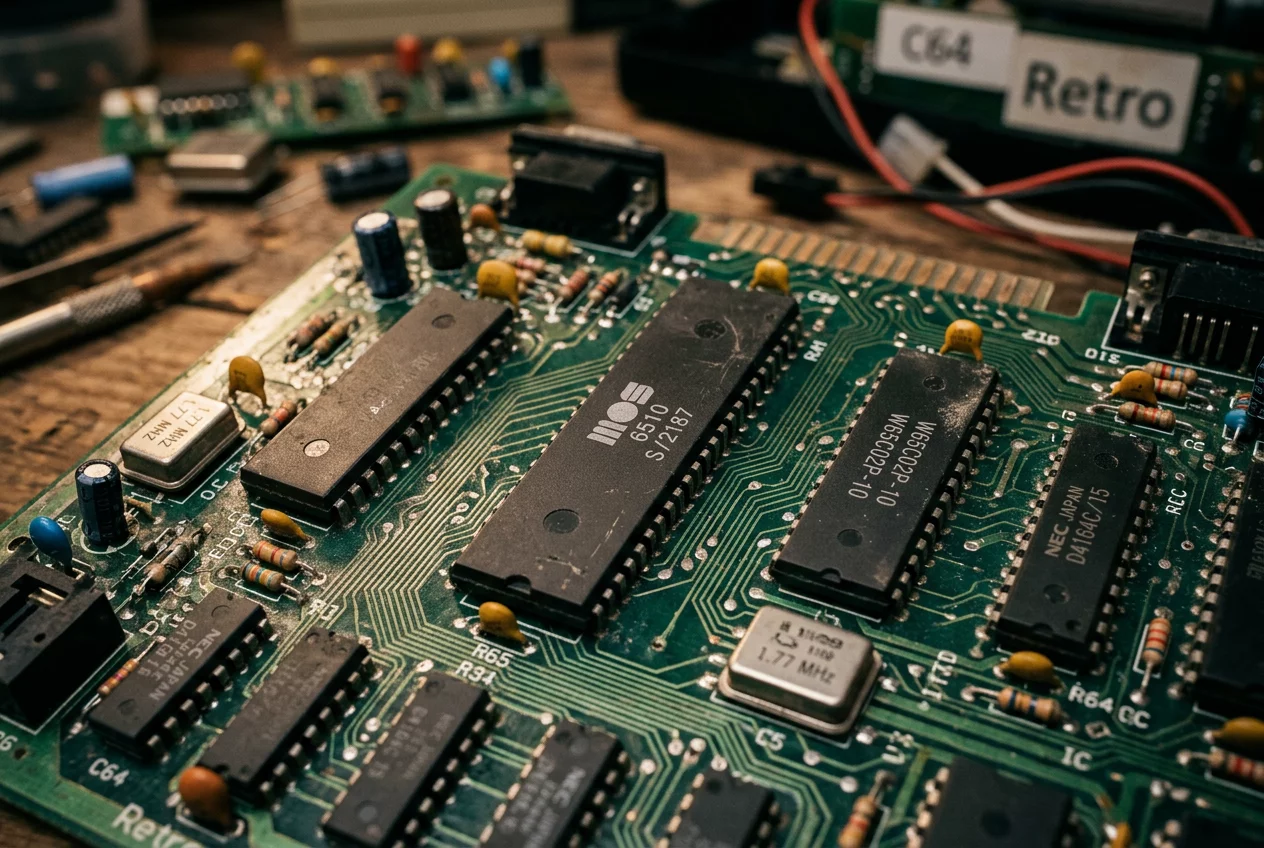
When we crack open a standard 8-bit cartridge, we aren't just looking at a piece of plastic and some wire. We are gazing into the heart of a era where every Byte was a precious commodity. The printed circuit board (PCB) inside an 8-bit cartridge is a masterclass in efficiency. Unlike later generations that used complex multi-layer boards, these classics often relied on simple single or double-sided routing to connect the ROM chips to the connection pins.
The layout typically features a primary ROM chip storing the game data. In some more advanced cases, you will find additional "Mapper" chips. These chips were ingenious workarounds for hardware that could only "see" a small amount of memory at once. By switching banks of data in and out, mappers allowed developers to create worlds far larger than the original console design ever intended.
Stability was paramount. The traces on these boards are thick compared to modern standards, designed to survive the rigors of being shoved into consoles and occasionally subjected to the humidity of the infamous "blowing ritual." The grounding planes are generous, ensuring that the 5V signals remain clean as they travel from the console's power supply through the cartridge connector and into the memory cells.
TRANSMISSION LOGS
Kevin Flynn
2026-05-11The simplicity of these boards is exactly why they are still running 40 years later. No capacitors to leak, just solid silicon.
INITIATE TRANSMISSION