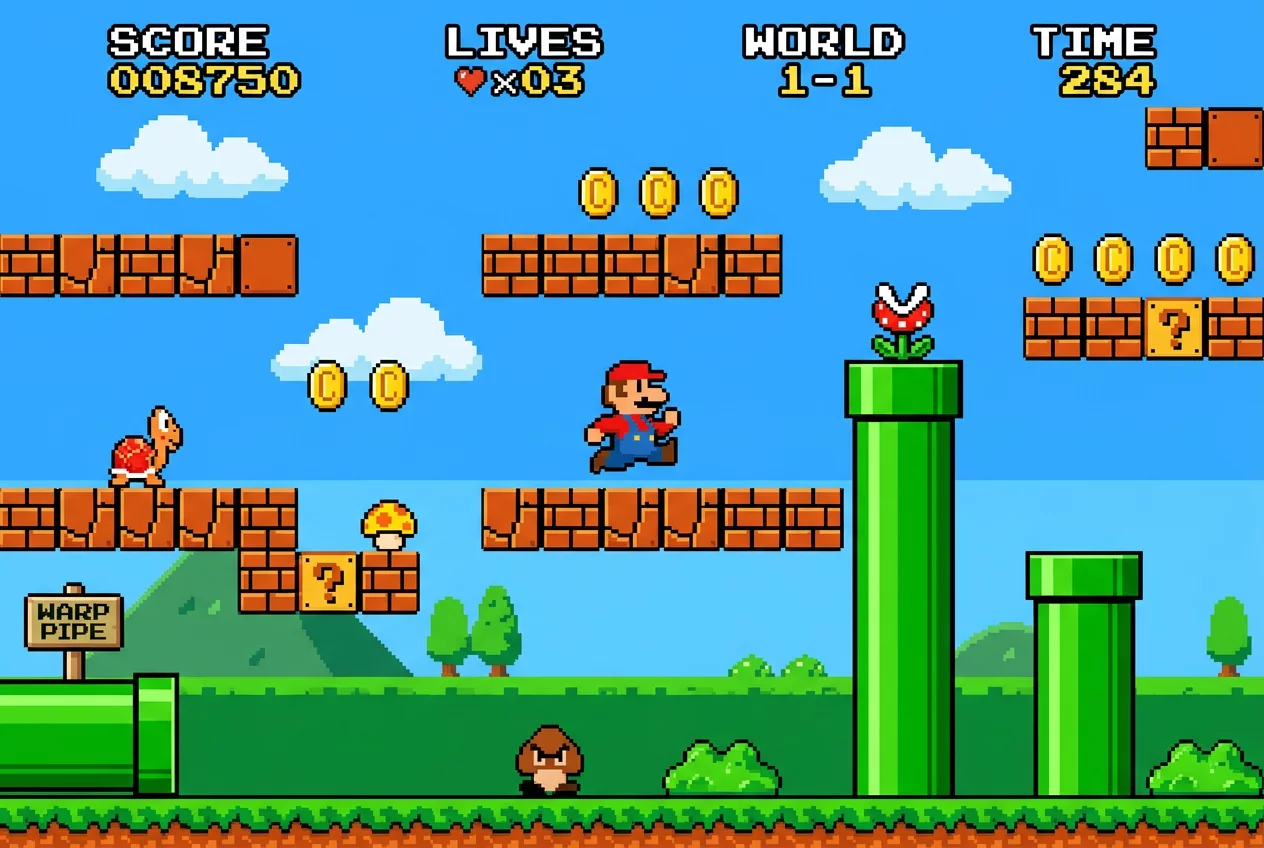
The golden era of the 8-bit and 16-bit generations was defined by the constant struggle against hardware limitations. Memory was an expensive, scarce resource that forced developers to invent clever architectural solutions to deliver sprawling worlds. Platformers utilized tile-based graphics to save memory, reusing small graphical blocks to build massive levels. Instead of drawing every tree and brick as a individual image, engineers divided the screen into small squares—usually 8x8 or 16x16 pixels—stored in the ROM chips of the cartridge.
Decoding the Tile Layer System
At its core, a platformer world was essentially a grid of pointers. By referencing a single tile multiple times across a map, developers could create complex forests or castles with only a handful of actual textures. This repetition was rarely noticeable to the player because of clever palette swapping. By changing only the color profile of a specific set of tiles, a sunny meadow could instantly transform into a moonlit grove without consuming a single extra byte of graphical storage. Developers inside these studios spent weeks optimizing these "character sets" to squeeze every possible ounce of variety from the limited silicon.
Collision detection posed another architectural challenge. To keep the processing load low, games didn't calculate physical interactions pixel-by-pixel. Instead, they assigned meta-data to certain tiles. A solid brick tile would have a bit flag indicating it was "impassable," while water tiles might be flagged for "buoyancy" logic. When the player character moved, the system checked the underlying tile ID rather than performing complex geometric calculations. This tile-based physics is why players occasionally clipped through walls or found "secret" passages—an accidental result of missing or misplaced tile metadata.
Sprite Multiplexing and Raster Effects
While the background stayed relatively static in its grid, the characters and enemies moved freely. These "sprites" had their own technical constraints. Most 8-bit systems could only display eight sprites per scanline before they began to flicker or disappear. To bypass this, programmers implemented sprite multiplexing, rapidly swapping which sprites were rendered on alternating frames. This created the classic 90s flickering effect, but it allowed for busier boss fights and more onscreen projectiles than the hardware technically supported. Inside these cartridges, every scanline was a battle for processing priority.
USER FEEDBACK
SUBMIT DATA LOG